
Keratoconus Help Resource

CTAK for Keratoconus: Treatment Options & Consultation

CTAK, or Custom Tissue Addition for Keratoconus, is a tissue addition procedure designed to reshape the cornea, improve regularity, and help reduce the need for corneal transplant in selected patients.

Helpful education. Real treatment guidance.
Beverly Hills and Westlake Village specialist support.
Dr. Rajesh Khanna, MD for CTAK keratoconus consultation
Dr. Rajesh Khanna, MDKeratoconus Specialist
Beverly Hills & Westlake Village

What is CTAK?

CTAK stands for Custom Tissue Addition for Keratoconus. It involves adding a thin, custom-shaped donor tissue lenticule into the cornea to help flatten and reshape the cornea.

This can improve corneal regularity, enhance vision quality, and may help delay or avoid the need for corneal transplant in selected cases.

When CTAK may be considered

  • Moderate to advanced keratoconus
  • Irregular corneal shape
  • Poor vision quality
  • Contact lens intolerance
  • Concern about transplant
  • Desire for tissue-based treatment

What CTAK can and cannot do

CTAK may improve corneal shape and vision quality in selected patients, but results vary. It is not a guarantee of perfect vision.

Glasses, specialty contact lenses, or other procedures may still be needed for best vision in some cases.

Why CTAK matters

Without CTAK

  • ✓Worsening corneal irregularity
  • ✓Dependence on specialty lenses
  • ✓Visual distortion and poor quality
  • ✓Concern about corneal transplant
  • ✓Limitations with daily activities
!

With timely CTAK guidance

  • ✓Customized corneal reshaping
  • ✓Stronger optical regularity
  • ✓Potential visual improvement
  • ✓Preserving future options
  • ✓Tissue-based treatment planning

Where CTAK fits in keratoconus care

SymptomsNotice changes in vision
→
Corneal
Mapping
Detailed imaging
→
Confirm
Irregularity
Diagnose and assess severity
→
CTAK
Planning
Custom tissue measurement
→
CTAK
Procedure
Tissue addition to reshape cornea
→
Visual
Rehabilitation
Optimize vision with lenses
→
Ongoing
Monitoring
Regular follow-up and care
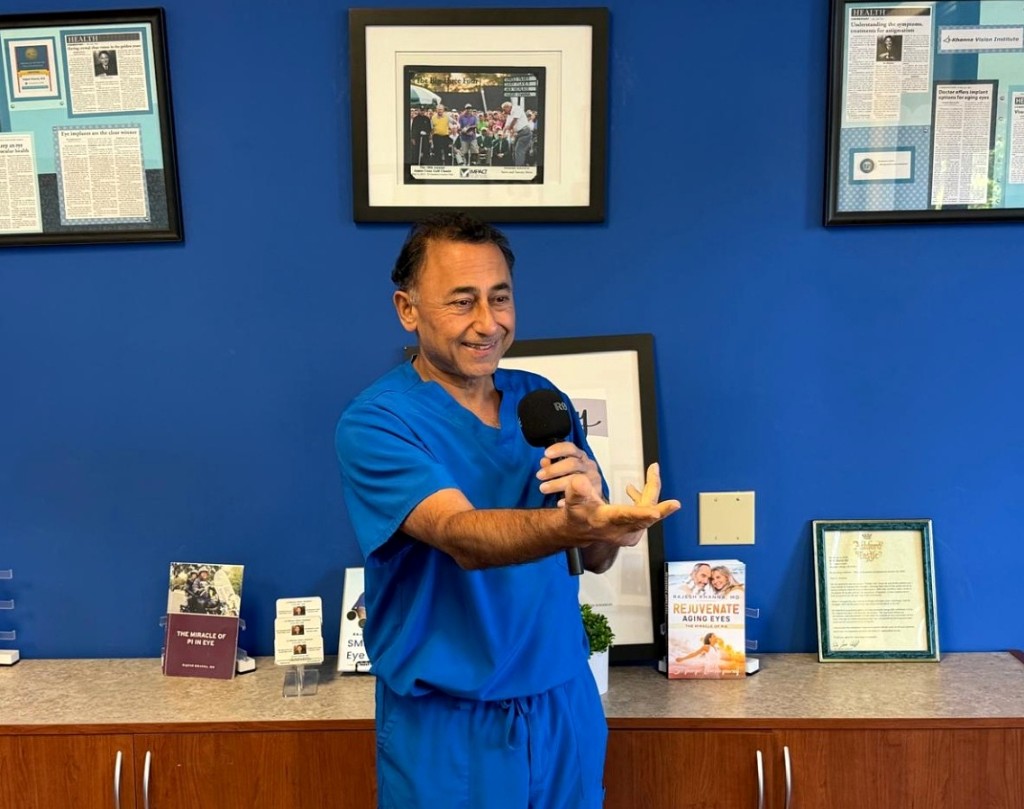
Dr. Rajesh Khanna explaining CTAK for keratoconus

Guidance From Dr. Rajesh Khanna, MD

Every keratoconus case is different. I carefully evaluate corneal imaging, review progression, and discuss whether CTAK may be the right option for you.

My goal is to help you understand your choices and create a personalized plan for the best possible outcome.

What happens next?

Step 1

Review symptoms and scans.

Describe your vision concerns and bring corneal scans to the evaluation.

→
Step 2

Understand if CTAK is appropriate.

We evaluate your case and discuss options.

→
Step 3

Get guidance on next steps.

Receive personalized recommendations and plan.

Book Your Appointment

Location *
Date & Time *
Captcha *

Your requested date and time are preferences, not confirmed appointments. The office will contact you about availability. This form does not accept medical scans or emergencies. For urgent eye symptoms, call your eye care clinician.

Do not wait if keratoconus is affecting your vision.

Get expert guidance and explore if CTAK is right for you.

Keratoconus Evaluations in Beverly Hills & Westlake Village

Dr. Rajesh Khanna, MD, sees patients at Khanna Vision Institute in Beverly Hills and Westlake Village. Patients from Los Angeles, West Hollywood, Century City, Thousand Oaks, Agoura Hills and Calabasas can ask about corneal mapping, progression checks, specialty contact lenses, cross-linking and advanced options. An examination determines which options are appropriate.

Frequently Asked Questions

CTAK stands for Custom Tissue Addition for Keratoconus. It is designed to add custom-shaped donor tissue to help improve corneal shape in selected keratoconus patients.
Intacs use plastic ring segments. CTAK uses a custom-shaped tissue lenticule. The right option depends on your corneal shape, thickness, vision needs, and specialist evaluation.
CTAK may be considered in selected moderate to advanced cases, but candidacy depends on corneal imaging and overall eye health.
Some patients may still need glasses or specialty lenses after CTAK. The goal is to improve corneal shape and vision potential, not guarantee perfect unaided vision.
Your doctor can explain the realistic options and limitations during consultation. Reversibility and future treatment planning depend on the individual case.
Recovery varies. Many patients return to normal routines within days, but vision and corneal shape should be monitored over time.

Beverly Hills

9100 Wilshire Blvd, Suite 265E, Beverly Hills, CA 90212, United States

+1 310-482-1240Beverly Hills location

Westlake Village

31824 Village Center Rd F, Westlake Village, CA 91361, United States

+1 805-230-2126Westlake Village location